Thursday, April 30, 2015

Improvisation

This week I am struggling with the horrible cold, cough, fever, aches and pains virus that has been going around our school, but it is easier to get through the day in school, than complaining in bed..so instead, I go straight home after work and go to bed for the night.  I am beginning to feel well enough to write my blog today, later in the week than usual!  I figured I would just let it go this week, but I was on vacation last week, so I hated missing two whole weeks without visiting with all of you.

This morning the radio went on and it was the BBC interviewing a Danish jazz musician who believes we need to improvise in life the way jazz musicians improvise on melodies.  He said that we make too big a deal about making mistakes, and that in jazz music, often a mistake can be the beginning of a beautiful improvisation.  He said Miles Davis taught him that.  He said that there really are no mistakes, only chances to improve style, form and design.

He said, in life this is true also.  He says that improvisation in life is something we all need to incorporate into our own lives.  A mistake is never a mistake so much as an opportunity to create something new, or to go in a different direction.  I think we all need to believe in this more.  We come from a frightening dialectic that there is only this view of good and bad, failure and success, is it possible that we have been viewing this all wrong?  I do have to wonder about that.  Is it possible that we have taken the idea of "not getting it, yet" as "failure" instead of possibly thinking of it as important information for a new viewpoint?  A different twist, a different take?  I think that's possible.

Let's put this into educational terms.  There are many articles recently about allowing students to "fail".  They say there is a stigma attached to failing and we need to squelch that notion as soon as possible.  That the only way to success is trying something enough times so that you can get it.  But why do we have to point to the idea of failure all the time, each time a child doesn't get it.  Can't we see it as a step in the right direction, or the beginning of something accomplished, or any other way of encouragement.   Perhaps we just need to eradicate the word "failure" from our lexicon, and come up with another way of talking about "not getting it".  It is a spectrum, after all, let's just think of it that way.  I never say to kids, "Oh, you failed at that piece of music."  Instead, I say, "There were some notes that were correct, and you had the feeling in the piece going well, but we need to practice that piece more before you should move on to something more difficult."  Failure, in my business, never comes into any discussion.  Why should it?  A new piece might have come out of the wrong notes that my student was playing.  I have been known to say, "That's not quite right, but it might be better than the original."  Let's just re-think our idea of what is right and wrong, and riff and improvise all on that, shall we?  And we really need to re-evaluate the use of the word failure, it is getting really annoying!!!  When we use that word it seems really final, and that is not how we teach.


 Chances, opportunities, wonderful melodic formations can be beginning, as long as we don't tell kids that they have failed..


Monday, April 13, 2015

I don't even know..

I am about to finish a novel about a professional blogger, and I realize I have been blogging for almost a year and I have no idea how to do it.  The blog that this woman writes is so edgey, so intense, so provocative, that she gets all kinds of mail, hate mail, support mail, and people re-post and re-post and go on and on.  I am, frankly, Ms. Frankly, just trying to share what I do with some other people who might be out there interested in the real experience of a middle school music teacher.  I remember, for example, a terrifying Saturday Night Live parody of a music teacher from many years ago, with a music teacher trying to get a class's attention, playing the electric piano, and losing the audience/class by the second.

That is not my experience at all.  I take my work seriously, but we have fun.  For example, this week and last week, we are writing plays using the meaning of songs for our points of departure.  I have realized recently that popular music these days is very lyric-heavy.  When you look at a song for the first time, it doesn't always mean what you think it does at the beginning.. I have students who have chosen some very interesting songs, "Mean", "Rude" "Counting Stars" "Viva La Vida" "The Eye of the Tiger".

 I began this project by singing "Titanium" with the students and having a discussion about the song.  What is it about?  What does it mean?  Why does she talk about "ricocheting" bullets and "Titanium" and "you have further to fall"?  Is the song about shooting at someone?  If you look closely, it is all about bullying.  But, one of my students today said something very interesting:  "Sometimes you have to be bullied to learn how to stand up for yourself and others."  I found this thought very evolved, as we talk about bullies all the time, real ones, cyber bullies, all the different sorts.  If we learn how to deal with them, we can be strong in later life, this boy said.  I was impressed, and talked further about this.  We were bullied as kids, and never had a grown up step in to help us.  We just kept it all to ourselves, and carried on.  These are wounds that leave scars, but I know that the middle school was the hardest for me, which is why I teach it.  I have been trying to protect my students every since, or at least teach them to stand up to those "bullets" that "ricochet".

Anyway, if you can take a song's meaning, and then create characters, and create a play around all of it as well, then you are in a place to really work with a group, evaluate artistic projects, and you can explain how the arts helps people understand what is going on in our culture today.  If you chose a song from the 60's, you might have to base your play on some event from the Vietnam war, or the civil rights movement, or some sense of freedom of speech or rights for women.  If you choose a song from today, you are more likely to be dealing with break-ups, the paparazzi, the way rich people deal with less rich people,  body image, death, bullying, or identity.


 I leave you with the link to Titanium, by David Guetta, written by a man but sung by a woman.. I think the songs show the changes in our culture better than any other art form, and it is immediate and very revealing.  I hope my students will get that from this experience.  That is my hope for today.  Titanium David Guetta lyrics Youtube

Tuesday, April 7, 2015

Make Our Garden Grow

It is the beginning of the fourth quarter of the year 2014-2015..There is something to be said for knowing where you are in the year.  You can judge where you have been, you can take stock of what you have accomplished, and you can see what time you have left and where you have to go.  That being obvious, it is also a complicated process when you are working with proficiency based learning, and proficiency based assessments.

When do you draw the line?  When do you say to a student, it is too late to go back and take that assessment again?  When do you say, you never did that assignment at the beginning of the last quarter when it was assigned, why is it ok to hand it in at the beginning of quarter four, and say that you deserve a mastery on that project?  I think there are varying opinions on this score, and I know that there have been many heated discussions amongst fabulous teachers that have shown that there are viable reasons for these opinions.   However, if we are proficiency-based from beginning to end, then you have to accept work whenever it has gotten to a proficiency level.  That is another reason NOT to translate into old-fashioned grades.  It won't compute at all, to take an assignment from another quarter and try to translate it into conventional grading practices.

 Finally, we must ask, what is the standard?  What did the student work on to find his or her way to proficiency in that standard?  Did that student meet that standard?  Did that student do all that was required to meet that standard?  Is that student prepared to move onto a higher and more complex level?  Can we say that this student has truly mastered this standard, and can both remember it for further use and also can and would want to go to a deeper and more sophisticated level with it?  If that is the case, then we must give that student a mastery, a green light, and continue to keep that child engaged, learning, enthusiastic, coming to school regularly, ready to face the next challenge, and the next challenge and the next one.


I have never believed in grades.  I, myself, have never been motivated by grades other than that I was afraid to fail or be mediocre.  I was afraid of getting a C because my sisters were so brilliant and I was considered the "not as smart one with a talent" growing up.  I couldn't test well to save my life, and I had test anxiety so much so that I almost flunked the written driving test when I moved to Chicago at 24 years of age.

I have since realized many things about myself, and especially the ways I am motivated to learn, to grow, to challenge myself.  It has helped me to see all the benefits of motivating students in a positive way.  I know my students don't have to take a Smarter Balance test about Modest Mussorgsky or the notes of the scale.  I am grateful of this every day.  The anxiety for me is only my motivation always to do the best and to be the best that I can be.  I only wish to, as said in "Candide" to "Make Our  Garden Grow".                                   Make Our Garden Grow  

Thursday, April 2, 2015

Mussorgsky inspired pictures

This has been one of the best weeks of school, speaking only in superlatives, of course.  I have been gifted with wonderful pictures at an exhibition, let me share those first.  This is an interpretation of "The Ballet of the Chicks in their Shells"..        


This is a picture inspired by "The Old Castle"

Here we have the "Great Gate of Kiev"

This was inspired by "The Hut on Fowls' Legs"

Here is another "Old Castle"

And if you would like to hear the music that also inspired some of these pictures, let me direct you here: https://www.youtube.com/watch?v=DXy50exHjes

Let me leave you here for this week.  It has been a very busy week, and I just want to say, the pictures and the music say what words cannot or will not say.  Enjoy the pictures, enjoy the music, speak to me or send me pictures or links that you would like to add to this.  Have a great week! 


PS- The GNOME 


Wednesday, March 25, 2015

Annie- April 2,3,4 York High School..7pm, 7pm, 1pm..

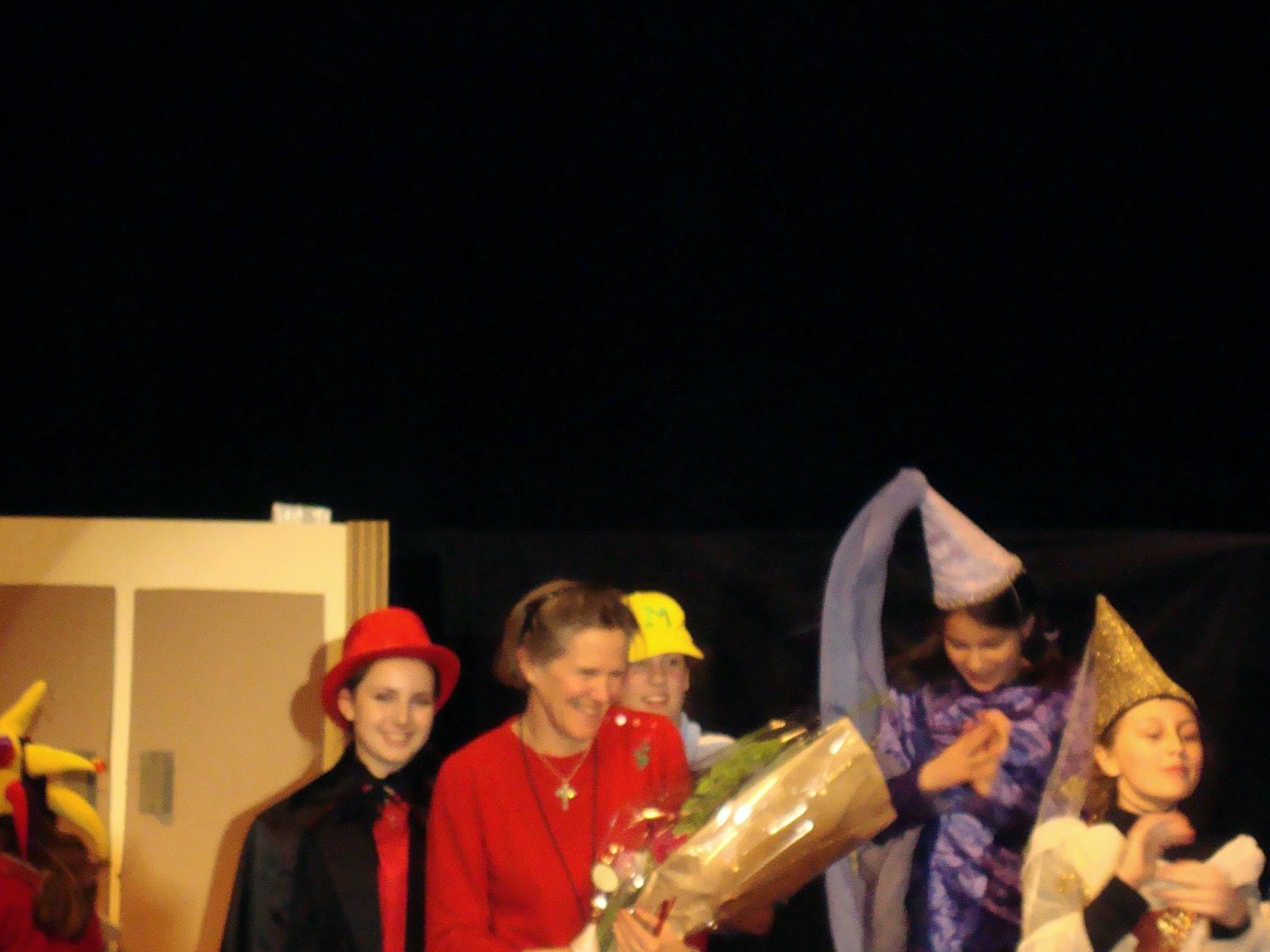
Next week York Middle School Drama Club will present "Annie, Jr".  It has been an incredible experience to direct this show.  This is not the first time we have directed and produced "Annie, Jr"- this is the second time at York Middle School.  The first time was my first collaboration with Mr. Carbone, a retired Horizons teacher at YMS and an actor, director, producer of many community productions in Connecticut.  The first time we did this show, we were less sure of each other, less sure of what our students were capable of..now we are pulling out all the stops!

We have an extraordinary cast.  Every girl cast as an orphan is a triple threat, and doesn't even realize it.  They all know each other's lines, so if someone is sick, (which has happened a lot this winter) there is always someone to take the line.  They never forget choreography or blocking, and they never break character.  The most amazing thing is how humble they all are, taking direction, listening to all of us, trying to get better at every turn.  Humble to the core, is what I can say.  The main characters are team players..Miss Hannigan is played by a brilliant talent that has now had a lot of experience in a short period of time.  She was a princess last year in "The Phantom Tollbooth" and has had summer experiences at Ogunquit Playhouse for a few years, so she has that character etched into her sinews at this juncture.  She is a happy child, but as Miss Hannigan, she is angry, cruel, intense, loud, frustrated, hurt, and under enormous pressure.  This all comes through in her song, her demeanor, her costumes, her facial expressions- priceless.

Our Annie is demure, motherly towards the other orphans, subtle in her emotions, her facial expressions are beautiful and her proficiency is remarkable.  I think she was memorized at the first blocking rehearsal.  Her singing voice is of an angel, yet it cuts right through to the back of the house, and she has subtle emotion driving every line of "Maybe" and "Tomorrow".  Her sophistication is impressive, she will be our new model for what Annie is supposed to be all about..not scrappy as much as intelligent, and soulful, truly working to bring herself and her orphan friends up a notch.  It has been an effortless experience working with her, and with the sensitive and kind girl playing Drake, as well as the thoughtful and intellectual girl playing Daddy Warbucks.

The fifth grade girls playing Lily and Rooster are phenomenal, I hope they return for even more challenges next year, they are fabulous!!! The two boys in the show are real troopers, also.  They keep us all believing that someday this will be an activity that will be as much about boys as it is about the girls fulfillment of goals.   We are fortunate to have a cast that is a metaphor in itself for community.  They help each other, they pitch in with all the props and sets and costumes, they are becoming a well-oiled machine..

DON'T MISS IT IF YOU CAN POSSIBLY BE THERE.  I know for a fact, you will be glad you came, glad you saw the next generation of singers/dancers/actors on that stage, glad you realized how many people get involved in this activity all winter long.

These are photographs from last year's performance, I will post photographs from this year, when I have them available to me.

Thank you in advance to all the students, parents, teachers, helpers, and audience who have helped us become and remain a self-sustaining club all these years.  Break a leg to all the performers next week and hope to see you all there!!!  

Tuesday, March 17, 2015

Modest Mussorgsky- Pictures at an Exhibition

MODEST MUSSORGSKY
Mussorgsky was a creative genius.  He was more original than any other Russian composer of his time.  He experimented with new melodies and harmonies. He was famous for his new kind of melody called “The melody of life”.  HE SAID, “IF I SUCCEED, I SHALL BE A CONQUEROR IN ART AND SUCCEED I MUST.”  HE WANTED HIS CHARACTERS TO “SPEAK ON STAGE AS THEY WOULD IN REAL LIFE, AND YET WRITE MUSIC THAT IS THOROUGHLY ARTISTIC.”  He was best known for his operas and songs, because he opened up new paths in terms of melodies, harmonies and rhythms, and yet he also took advantage of the rich Russian folk culture to which he had been exposed all his life.


He was born on March 21, 1839, to a rich land owning family, in Pskov.  He received music training from his mother and Anton Hernke, and though he published a piano piece at sixteen, he was supposed to go into the army.  He graduated from Cadet School and became a member of the Peobrazhensky regiment.  He met Balakirev and Parghomszksky which re-inspired his musical interests.  He studied with these men for a short time and wrote songs and two piano sonatas.  He finally resigned his army commission and devoted his time to composing music.  He wrote his Scherzo in B-flat for orchestra whose premiere was conducted in St. Petersburg on January 23, 1860.  


When the Russian slaves were freed in 1861 the Mussorgsky estate had to be sold, and the composer had to get a real job, as a clerk from 1863-1867 in the Ministry of Communications.  However, he continued to compose music.  In 1864 he completed the first act of his opera, “The Marriage” in which he experimented with speech-like melodies for the first time.  Between 1865-1866, he completed several remarkable songs, and between 1860- and 1866 he completed sketches for his first orchestral work “Night on Bald Mountain.” (This piece was in Fantasia, if you have ever watched that movie by Disney.)


In 1869 he went back to government service, and for the next eleven years worked for the department of forestry.  He was suffering from nervous disorders and he was an alcoholic and sought out the company of disreputable people.  Even with all these problems, he managed to produce a number of beautiful pieces of music that are well known to this day:  Boris Godunov, 1874, Sunless and Songs and Dances of Death, Pictures at an Exhibition for piano, two operas he never completed “Kovarinchina” and “The Fair at Sorochinsk”.  He died in St. Petersburg on March 28, 1881.  


PICTURES AT AN EXHIBITION:  This piece was originally written for the piano by Mussorgsky, but was orchestrated by Maurice Ravel, a French composer.  Mussorgsky wrote this piece after he visited an exhibit of paintings by a friend, Victor Hartmann, who had died.  The pictures inspired him..”The melodies come to me of their own accord..I can hardly manage to put them on paper fast enough.”  He chose nine of his friend’s pictures and sketches for musical ideas.


This is a suite, which is a group of pieces strung together but with separate sections and presented as one longer piece.  
1.) Promenade: This section shows the composer walking from picture to picture in the exhibition and it repeats several times throughout the piece of music.  


2.) The Gnomes: sprightly melody with offbeat rhythms, a design for a nutcracker.  


3) Old Castle: a sad sounding song that is inspired by a castle with a troubadour in front of it.


4) Tuileries: A picture of the famous garden in Paris.  This comes from the painting by Hartmann of his children playing with their nannies.  It has jolly confusing melodies and lively rhythms.  


5.) Bydlo: This is a Polish ox cart, and the music is slow and heavy like the slowness of the cart.  


6.) Ballet of the Chicks in their Shells: This is inspired by Hartmann’s designs for costumes and a setting for the ballet.  The music is fast and full of bird-like sounds with the use of many clarinets and flutes.


7.) Samuel Goldenburg and Schmuyle: a portrait of two Jewish men, one grand and rich, portrayed by a proud, stately melody, the other one poor, and humble and is introduced by a weak, indecisive subject.  


8.) Limoges Marketplace: a fluttering melody with leaping rhythms that suggest housewive’s gossip.  


9.) Catacombs: The somber melody here shows the darkness of the catacombs, where skulls and bones are left.  Mussorgsky wrote of this section, “ the creative spirit of the dead Hartmann leads me toward skulls”.  The skulls are lit up inside.  


10.) The Hut on Fowl’s Legs:  An oriental design of a clock in the shape of a hut, standing on chicken feet and showing off two rooster heads, gave the composer his next inspiration.  This picture made Mussorgsky think of Baba Yaga the witch, as she soars through the air looking for her victims.  It is based on a Russian folk song.  


11.) The Great Gate of Kiev: The suite comes to a close with a description of “The great gate of Kiev” in Russia.  This was a sketch by Hartmann for a projected monument in Kiev.  


The theme of the Promenade returns between several of the sections, to show the composer walking from picture to picture as if in a museum at an exhibition.

Tuesday, March 10, 2015

Islands

Once in a while I like to blog about my creative drama class.  This quarter I am working with a group of fifth graders.  Perhaps they would rather be somewhere else, probably gym, recess or lunch, but I have been impressed with their focus the last few classes, and their ability to listen and take direction.  They have improved greatly since the first day of class.

On Friday we played a creative drama game called "Islands".  This game creates and builds community if played correctly.  The rules are simple.  You take several sheets of newspaper and put them down on the floor.  The newspaper sheets should not touch, there should be room for students to walk around the floor between the newspaper sheets.  There should be one less than the number of students playing the game.  When you say go, students walk around the room, not touching the "islands", as if they are swimming in the ocean.  When you say, "Shark" students must find a sheet of newspaper to stand on to get away from the shark.  Each time students go onto the sheets of newspaper you take one more piece of newspaper off the floor, so students have to share more and more space with each other.  You keep playing until you can't fit any more kids onto the pieces that are left.

When I described the game, the students first reaction was to say, "how do you win this game?"  I told them it is not about winning and losing.  It is about creating community.  They wanted to change the rules of the game.  If you don't get onto a sheet of newspaper, you are out.  I said, it is not about kicking someone out of the group, it is about including everyone, any way you can.  I told them to just try it out.

It was incredible.  I played quiet music and then when I stopped it, they all jumped to the newspaper sheets.  The more sheets I took away, the more people had to fit on small sheets of newspaper.  That meant that people had to hold onto each other, and some people by the end were carrying each other so they could fit together on the newspaper squares.  They were saving each other, instead of kicking each other off, and jockeying for position.  I was impressed.  Once they got the idea of the game, they were very receptive to it.

We had a reflection discussion after the game, and everyone managed to enjoy themselves a great deal, despite the fact there were no losers, only winners and survivors.  Why were there survivors?  Thrivers in fact?  Because we all worked together to stay away from the shark.  Some students said they still enjoy competition, and I said there is nothing wrong with that, it is just a completely different experience if you are helping each other, rather than trying to push each other out of your opportunity.

 Let's build community instead of creating more opportunities to compete with each other.  I think there will always be enough of those.  I hope students in my creative drama classes learn from these experiences that they will always need to do their best if they want the group, or the family, or the business or the play to be a success.